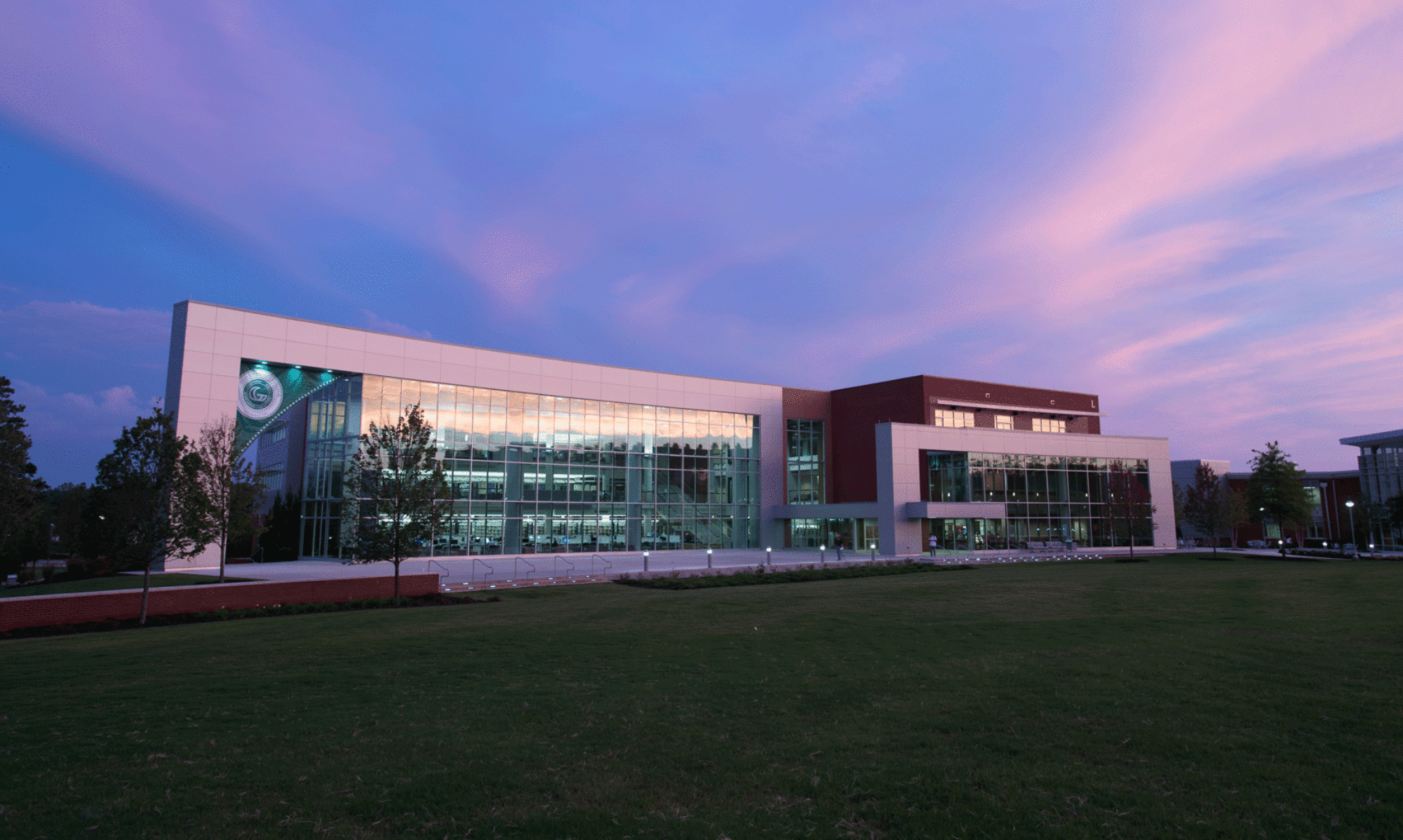
The CTE’s 2026 Winter Institute will be held in the CTE (L-2135) on Wednesday, January 7th. The focus of this year’s institute will be on student engagement; faculty and staff are invited to join us at any time between 9:00 AM – 4:00 PM for personalized support and to engage in interactive sessions. No pre-registration is required.
We will host an Open Lab in our Faculty Instructional Design Lab (FIDL) for one-on-one instructional support from 9:00AM-4:00PM, and there will be “10-Minute Talks” in our conference room at the top of each hour. Here are some of the exciting “10-Minute Talks” you can look forward to:
9:00 a.m.: TBD (Susan Bussey)
10:00 a.m.: “AI-Assisted Presentations” (Josh Morris)
11:00 a.m.: “Why Do I Teach Like This? A 2-Minute Transparency Technique: (Jason Delaney)
12:00 p.m.: Break for lunch (on your own)
1:00 p.m.: “Grading ChatGPT: Critical Thinking with AI” (Adam Hutcheson)
2:00 p.m.: “The Improv Presentation” – (Chantelle Anfuso)
3:00 p.m.: “Increasing Student Engagement via Gradebook Strategies” (Binh Tran)
We invite you and your team to stop by CTE (L-2135) for individualized support, to engage in one of the interactive sessions, or just to connect with colleagues and learn more about what the CTE has planned!
10-Minute Talk Descriptions:
9:00 a.m.: TBD (Susan Bussey)
10:00 a.m.: “AI-Assisted Presentations” (Josh Morris) – AI-assisted presentations provide a balanced way to teach responsible AI use without letting students outsource the entire assignment. Students can use AI for idea generation and research, but they must verify information, design slides, and present in their own words—building AI literacy while maintaining ownership and accountability.
11:00 a.m.: “Why Do I Teach Like This? A 2-Minute Transparency Technique: (Jason Delaney) – In this 10-minute talk, Dr. Jason Delaney shares a simple perspective-taking strategy that builds trust, gets student buy-in, and shifts the classroom culture toward collaboration. Before the instructor explains a policy or assignment structure, students are asked to guess the rationale. Their hypotheses surface assumptions, open the door to transparency, and make space for a clear, student-centered explanation. With repetition, students grasp the underlying philosophy behind the course design and see how the design supports their success. The session demonstrates the technique and shows how faculty can apply it immediately with minimal preparation.
12:00 p.m.: Lunch (on your own)
1:00 p.m.: Grading ChatGPT: Critical Thinking with AI (Adam Hutcheson) – This demonstration will show how to improve critical thinking in the classroom with generative AI.
2:00 p.m.: The Improv Presentation (Chantelle Anfuso) – This activity is designed to give students more practice in preparing presentations, while simultaneously developing teamwork and research skills. After a brief introduction to a topic, students are given a link to a mostly blank Google Slides document, with only titles on each slide. Students are broken into groups, and each group is tasked with preparing a single slide. After the slides are prepared, the instructor (without reviewing the slides beforehand!) gives the presentation to the class. This activity engages students with a topic by requiring them to work in a team to prepare something that will be presented to the class. Students can then critically analyze the effectiveness of their slide once presented. However, it reduces anxiety by removing the public speaking requirement, and builds trust and engagement with their instructor, who takes on the ‘burden’ of the presentation. This can be used as a warm-up practice for student presentations, or simply as a fun exercise to engage with students.
3:00 p.m.: Increasing Student Engagement via Gradebook Strategies (Binh Tran) – In this talk, we will discuss how faculty can increase Student Engagement by first making sure they are present and active and awarding them for actively engaging using course design and gradebook strategies.